
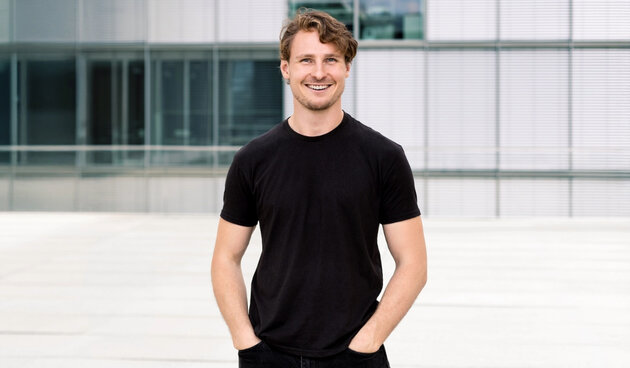
© Guido Schwarz / Kyrok
“We think people in supply chain are more than data entry and repetitive administration.“
Daniel Hofinger, CEO & Co-Founder of Kyrok
InterviewShare on:
A purchase order for 30 tonnes of a chemical material arrives as a PDF, gets printed out, carried into the next room, and typed into a second system by hand. This is the daily reality in many of Europe's pharma and chemicals plants – and it is precisely the problem that Berlin-based startup Kyrok set out to solve. Founded in 2025 by Daniel Hofinger and Lukas Bierfreund, Kyrok has developed what it calls the first AI operating system for supply chain teams in the European pharma and chemicals mid-market. With €3.1 million in pre-seed funding, led by Speedinvest and backed by industry heavyweights including ex-SAP CPO Dr. Marcell Vollmer and the founders of Langdock, the company is now expanding its platform and growing its Berlin team.
In this interview, CEO Daniel Hofinger talks about what he saw on factory floors that convinced him this was the right problem to tackle, why Kyrok layers on top of existing ERP systems rather than replacing them, and what it means for an industry facing a wave of retirements that threatens to take decades of process knowledge with it – at a moment when Europe's industrial base can least afford to lose it.
What did you see on the factory floors that convinced you this was the right problem to solve?
The moment I remember most clearly is a purchase order for 30 tonnes of a chemical material arriving as a PDF, getting printed out, carried into the next room and typed into a second system by hand. This is happening in plants that make highly complex medicines and chemicals. Between customer service, planning and procurement sit systems that are not connected, and the teams hold them together by hand and Excel spreadsheets. Much of the decisive know-how lives in the heads of a handful of experienced people. We heard the same story in more than 200 conversations across the industry.
Why was layering on top of existing ERP systems so central to your approach, and what does it take to make it work?
For a mid-sized manufacturer, tearing out the system that runs the plant is off the table. Production cannot stop, and a full Enterprise Resource Planning (ERP) migration carries real operational risk. So Kyrok runs on top of whatever is already in place, often an SAP system from the 1990s, and leaves it untouched. Making that work is the hard part. Our agents have to read unstructured input such as emails, apply the industry's own logic from dangerous-goods rules to end-batch processing , and write clean data back into the ERP without anyone tidying up afterwards.
We spent almost a year understanding these processes before we wrote a single line of code, and that groundwork is easy to underestimate from the outside. This is also why our product works so precisely and robustly despite the reality of messy master data and complex processes. That's why our customers are expanding to sister companies "as fast as possible" right now and recommending us to other pharma/chemical companies.
What does human-in-the-loop look like in practice, and how do you decide where AI acts and where a human stays in control?
The agents take on the preparation and the recurring work, but the final call stays with the person who carries the responsibility. Take an incoming order, for example. In the pharmaceutical and chemical industries, a single customer order often has to be broken into many production orders, depending on which batch each part flows into, and that split follows complex logic specific to the product and customer.
The agent reads the order, structures it and works out that split, 9 of 10 orders are prepared without any error. Then an experienced employee checks it and confirms before anything is written to the ERP. Every step is traceable, so the team can always see what an agent did and why. The harder and rarer the case, the more it sits with the person rather than the agent.
How does Kyrok help companies capture and preserve process knowledge before it walks out the door?
By 2039, close to a third of Germany's working population will have reached retirement age, and the production sites outside the big cities are hit hardest. In a lot of these companies, the most mission-critical knowledge sits within the heads of individual employees. How a particular order has to be processed, which raw material bulk is used for a production order, how a rare edge case gets handled. When that person retires, the experience usually leaves with them.
We start right next to the daily work, in onboarding workshops, and the system learns these patterns as people work. Process knowledge that used to depend on one person becomes something the whole team can draw on, so it stays in the company when the generation changes. We do this together with the workforce, never over their heads.
How do you build trust in this environment, and what has surprised you most?
In a regulated industry you have to earn trust. No company hands its core ERP system and date to a young startup because a demo looked good. We prove ourselves in real operations and work through each plant's own edge cases. We do not replace the existing systems, people keep control of every decision, and all data stays GDPR-compliant on European infrastructure.
What surprised me most, coming from the startup world, is how bad the systems actually are and how much repetitive administrative work people still need to do. People are gluing together systems right now, and our critical industries depend on it. We think people in supply chain are more than data entry and repetitive administration. The people running these supply chains know their tools are dated, and they see it first-hand when experienced colleagues retire and there is no one ready to take over the knowledge. If you turn up with a real understanding of how their processes work and a long-term commitment, the willingness to move is far greater than the sector's reputation suggests.
What does Berlin offer for an Industrial-AI-Startup like Kyrok?
Berlin gives us the talent we need, from AI engineers to people who have built enterprise software before, and it puts us among a lot of founders who have already been through this. Their experience feeds straight into Kyrok. The Langdock founders are a good example. Jonas Beisswenger and I built our first company together years ago, and today he and his co-founders are investors in Kyrok. Connections like that exist here because so many people in the city are on a similar mission.
Where will Kyrok be in two years, and what does success look like for you?
The customer service module is live with our customers today, the procurement module follows at the end of this year, and in 2027 we add production and material planning. At that point the operating system covers the whole supply chain. If a raw material runs late, procurement processes it straight away, planning adjusts instantly, and the email that tells the customer is ready to send with one click.
In two years, Kyrok will be in daily use across the mid-market pharma and chemical industry in the DACH region, and I want us to take action towards the rest of Europe. It will mean a manufacturer where the knowledge stays when someone retires, and medicines that reach patients because the supply chain behind them holds up. Additionally, Europe’s industrial base is in a very difficult situation right now. We strive to make them competitive again. This is our contribution to Europe’s industrial base for generations to come.
Thanks for the great conversation.


