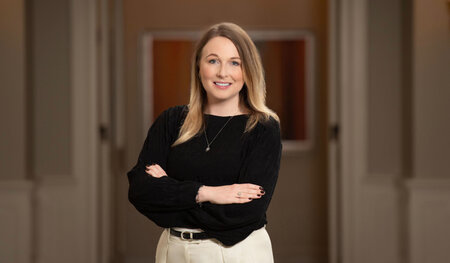

© Sinan Arslan, SIBB
“A livable digital future doesn't emerge from new technologies alone.“
Sinan Arslan, Managing Director of SIBB
InterviewShare on:
Since June 2026, SIBB's new incubator has been running with a focus on cybersecurity and trustworthy AI – part of the Berlin Startup Stipendium, funded by the State of Berlin and the EU (ESF+). Eight teams in the first cohort are working on topics ranging from trust infrastructure and cybersecurity compliance to bioinformatics, industrial applications, and wildfire management, supported with up to €100,000 in funding per team over ten months.
In this interview, Sinan Arslan, Managing Director of SIBB — the Software, Information and Communication Industry Association of Berlin-Brandenburg, with around 200 member companies — talks about why trust is becoming an increasingly important competitive advantage, what trustworthy AI actually means for early-stage founders — and why he believes Berlin is on track to become the leading location for trustworthy digital innovation in Europe.
Sinan, SIBB has been supporting Berlin founding teams since 2019 – and has now launched a new incubator focused on cybersecurity and trustworthy AI. What made you set this specific thematic focus?
We're currently experiencing a fundamental shift in how innovation happens. When it comes to AI, it's no longer just about what's technically possible. Companies today are asking much more strongly whether applications can be used safely, transparently, and responsibly. At the same time, the cost question is moving further into focus: Does the investment pay off? How do I use available resources efficiently and sensibly?
That's why we set our incubator's focus on cybersecurity and trustworthy AI. For us, the two topics are inseparable: the more AI becomes embedded in the economy and society, the more important trust, security, and resilience become. Startups have the chance to build these requirements into their products from the very beginning – and that's exactly where we want to support them. Our goal is to foster technologies that are economically successful while also contributing to a livable digital future.
Trustworthy AI is a term that's widely discussed right now – but what does it actually mean for early-stage startups? What do founders need to bring to the table today to build AI products that users, businesses, and society can genuinely trust?
For us, trustworthy AI means developing AI so that it can be used safely, transparently, and responsibly. For startups, that doesn't start with regulatory requirements or shortly before market entry. The decisive choices are made right at the beginning – in the choice of data, the traceability of decisions, or the question of how risks are minimized.
At the same time, we're observing that trust is increasingly becoming a competitive advantage. Going forward, companies won't just buy the most powerful AI, but the one that works reliably and can be deployed responsibly. Founders who think about this early on don't just build better products – they build more viable business models.
Berlin has developed into one of Europe's densest AI ecosystems in recent years, with currently around 600 AI startups and scale-ups. What makes Berlin so interesting as a location for cybersecurity and AI, in your view?
Berlin has always been a place where new ideas meet openness. That openness is an important location factor – especially for technologies like AI or cybersecurity. Here, research, startups, established companies, public administration, and civil society work closely together. That creates an environment where innovation doesn't stay in the lab, but gets measured early against real social and economic needs.
Our current incubator cohort makes this diversity very clear – ranging from bioinformatics to industrial applications to cybersecurity and wildfire management. That gives Berlin excellent conditions not just for producing new technologies, but for developing solutions to concrete social and economic challenges. Now it's about consistently translating that strength into market-ready innovation.
In the SIBB incubator cohort that launched in early June, eight teams are working on a wide range of projects. What patterns do you see across these projects – and what do they show about the development of cybersecurity, trustworthy AI, and deep tech in Berlin?
What impresses me is that all eight teams are working on concrete challenges. That shows how Berlin's startup ecosystem is changing. AI is increasingly becoming a foundational technology, while deep tech is emerging wherever scientific findings are translated into market-ready solutions. These companies aren't building off-the-shelf applications – they're working on technologies that solve complex problems in industry, healthcare, or critical infrastructure.
At the same time, one theme runs through many of these projects: trust. Whether it's cybersecurity, compliance, or reliable AI – these teams are building solutions for a digital economy that has to be not just innovative, but also secure and resilient
SIBB connects more than 200 tech companies as well as national and European institutions. What role do such networks play for early-stage startups?
Especially in the early phase, it's not capital or technology alone that determines a startup's success. Just as important is access to people who share experience, ask critical questions, and open doors. Networks create exactly those connections. They bring founders together with companies, academia, policymakers, and investors, and help them adapt their products early to what the market actually needs.
As an association, we see ourselves as a bridge-builder. We create spaces where knowledge, perspectives, and experience come together. That benefits not just startups, but also established companies that get in early contact with new technologies and can develop innovation together.
Looking three years ahead: Where should Berlin stand as a digital location by then – and what contribution does SIBB want to make along the way?
I'm convinced that Berlin will be the leading location for trustworthy digital innovation in Europe. We have excellent research, creative founders, and strong companies. On top of that, we have an outstanding infrastructure for early-stage financing and an increasingly strong network of investors, from business angels to VCs. Now we need to connect these strengths even better.
SIBB contributes to this by expanding networks, promoting knowledge transfer between startups, business, academia, and policy, and making it easier for young companies to enter the market. A livable digital future doesn't emerge from new technologies alone – it comes from developing them responsibly and creating real value for people and businesses.
Thanks for the great conversation.
Vita: Sinan Arslan is Managing Director of SIBB, the digital economy association for Berlin and Brandenburg. Since January 2025, he has led the association's strategic development and champions closer ties between business, startups, academia, and policy. Previously, he worked in strategy, transformation, and communications at mid-sized companies and remains active as an executive coach. His focus lies on responsible digitalization, innovation, and shaping a livable digital future.
Note: This interview was originally conducted in German and then later translated into German language.