
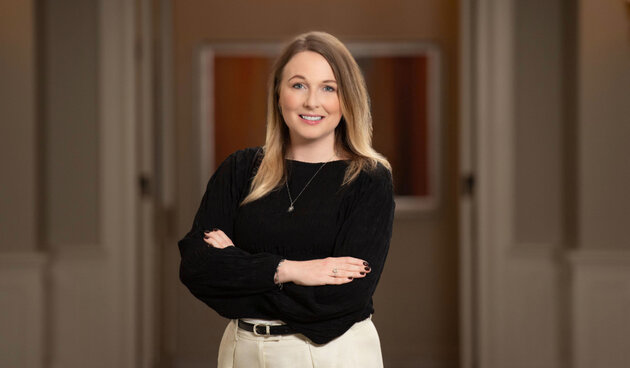
© Larissa Schneider / Unframe
“Digital sovereignty is not a contradiction to global growth.“
Larissa Schneider, Co-Founder & COO of Unframe
InterviewShare on:
In just twelve months, Unframe reached more than $100 million in order volume and is now considered one of the fastest-growing enterprise AI companies in the world. Founded in Silicon Valley in 2024, the startup promises to deliver tailored, production-ready AI solutions for enterprises within days — without replacing their existing systems. Co-founder Larissa Schneider serves as COO and steers much of the company's day-to-day operations from Berlin.
At this year's VivaTech in Paris, Schneider represented Unframe on the panel "AI Made in Berlin," speaking about the shift from AI experimentation to measurable business impact — and the obstacles still holding back European scale-ups. In this interview, she explains how Unframe enables AI transformation without upfront investment, why LLM-agnosticism matters for large enterprises, and what Berlin's AI ecosystem offers a globally growing company like Unframe.
Larissa, Unframe promises to deliver tailored, production-ready AI solutions within days and integrate them into existing enterprise systems. How does this approach actually work, and what has so far prevented companies from moving their AI pilot projects into operational use?
Unframe delivers AI transformations on a simple principle: together with the company, we identify the right use case, build the solution to production-readiness on our platform — and the company only pays once it's satisfied with the result. This is built on pre-built components, a flexible open architecture, and a proprietary data layer that integrates seamlessly with existing systems. The biggest problem in the industry isn't the technology — it's that companies have to invest too much, too early, before real value has been proven. That's exactly the risk we remove.
Your platform isn't tied to a specific language model and can run in the customer's cloud, on-premises, or as a managed service. Why is this openness and flexibility so crucial for large enterprises with complex data, security, and governance requirements?
Large enterprises have individual data, security, and compliance requirements — a one-size-fits-all solution simply doesn't work here. That's why Unframe is LLM-agnostic and can run on-premises, in the customer's own cloud, or as a managed service; data never has to leave the customer's own environment. As a founding team with a background in cybersecurity — Shay Levi previously founded Noname Security and sold it to Akamai for $500 million — we understand the requirements of CISOs firsthand, and that's reflected in everything we do: from our architecture to our certifications under ISO 42001, SOC 2 Type II, and ISO 27001.
Within twelve months, Unframe reportedly reached more than $100 million in order volume and raised an additional $50 million in growth capital. What specific problems are currently driving demand for enterprise AI the most?
The pressure is coming from the top: AI transformation has long been a boardroom topic, and companies that don't deliver now are falling behind their competitors. Studies show that early AI adopters achieve 92% higher revenue growth. But the real problem isn't the technology — it's the gap between pilot project and production deployment: consulting firms take months, in-house development is expensive and complex, and most companies have neither the time nor the internal AI expertise to solve this on their own. That's exactly where Unframe comes in: we deliver production-ready solutions for the most complex, business-critical use cases — in weeks, not months, and without upfront investment.
Delivering tailored solutions quickly sounds like it would be hard to scale. How does Unframe address individual requirements without starting from scratch technologically on every project?
The key lies in our platform architecture: every solution we deliver is built on the same reusable components — data connectivity, context layer, automation logic, UX/UI — which we apply and continuously improve across projects. That means the second solution is delivered faster than the first, the third faster than the second — the system gets smarter and more efficient with every implementation. We address individual requirements through configuration and customization, not through new development — that's how we achieve real scalability without sacrificing precision.
At VivaTech 2026, you talked about shifting the focus from AI experimentation to measurable value and real-world applications. How do companies know that a use case is actually ready for production deployment?
Pressure from leadership has long since arrived at most large companies — the strategic priorities are set. So the real challenge is no longer whether to deploy AI, but which business-critical transformations to tackle first. Whether the end result runs on a large language model, classic machine learning, or a deterministic workflow should follow from the problem — not the other way around. In my view, a use case is production-ready when it has a clearly measurable business impact, integrates into existing processes, and is actually used by employees — because in the end, what matters isn't the technology behind it, but whether it creates real value.
Unframe was founded in Silicon Valley, yet the operational business is largely run out of Berlin. Which strengths of Berlin's AI and tech ecosystem are especially relevant for you — in terms of access to talent, companies, research, and international networks?
Berlin isn't a random location for us — the city combines strong technical talent with a dense network of large enterprises that are looking for exactly the kind of AI transformation we deliver. At the same time, Berlin offers a natural gateway to the European market, where topics like data sovereignty, regulatory requirements, and responsible AI use aren't just being discussed, but actively shaped — that fits very well with our approach. And not least, Berlin's tech community has become more international than almost any other in Europe, which helps us find the right people quickly — whether as employees, partners, or customers.
At VivaTech, you raised fragmentation, access to capital, and regulatory hurdles as challenges for European scale-ups. What framework conditions does Europe need so that companies like Unframe can grow globally from Berlin while also contributing to digital sovereignty?
Europe has the ingredients: talent, industrial expertise, regulatory awareness — but we're still missing the shared market that would allow companies to truly scale from a single location, without starting from zero in every country. What we need is less fragmentation in access to capital and regulatory frameworks — not less regulation, but more consistent regulation that gives companies planning certainty instead of uncertainty. Digital sovereignty is not a contradiction to global growth — but Europe has to stop treating the two as separate goals, and start supporting companies that can deliver both at the same time.
Thanks for the great conversation.
Vita: For years, Larissa Schneider has observed how companies have embraced the vision of enterprise AI but then failed to make the integration truly productive. The tools are often cumbersome, and the ROI is barely tangible. It was precisely this frustration that motivated her to co-found Unframe. For a decade, Larissa led GTM and marketing at companies like Nutanix and Noname Security, always working at the intersection of complex technology and the teams that actually use it. She knows what it takes to successfully launch a product and what companies really expect from their software. At Unframe, the team is developing the AI layer that makes enterprise systems truly intelligent without disrupting existing workflows. Unframe has already raised $100 million in funding, based on the conviction that the gap between AI’s potential and its actual impact in practice can be bridged.
Note: This interview was originally conducted in German and then later translated into English language.


