
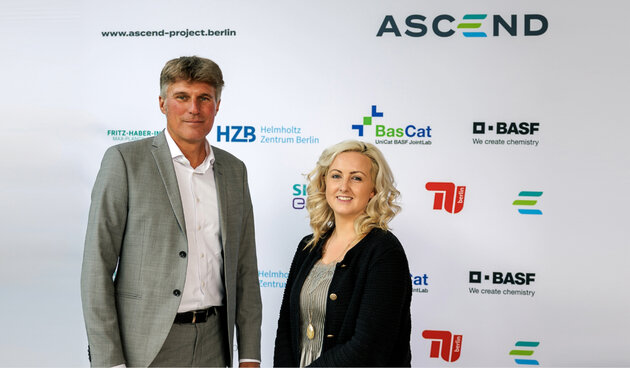
© HZB / K. Fuchs
“We aim to accelerate catalyst discovery from years to weeks.“
Prof. Dr. Karsten Reuter & Dr. Michelle Browne, ASCEND
InterviewShare on:
Berlin has long been known as a hub for AI research and digital innovation – but the city's ambitions reach far beyond software. With ASCEND, a new kind of initiative has taken root in the German capital: one that uses artificial intelligence and autonomous laboratories to tackle one of the hardest problems in climate science – the discovery of next-generation catalysts for a carbon-neutral future. On June 11, 2026, the project's official launch at Helmholtz-Zentrum Berlin drew Federal Research Minister Dorothee Bär, the presidents of both the Helmholtz Association and the Max Planck Society, and leading figures from industry and academia. Backed by 30 million euros in federal funding, ASCEND unites six partners all based in Berlin: HZB, the Fritz Haber Institute (FHI), BASF, Siemens Energy, Dunia Innovations, and TU Berlin/BasCat.
At the heart of the project are its two scientific coordinators: Dr. Michelle Browne, head of the Electrocatalysis: Synthesis to Device group at HZB, and Prof. Dr. Karsten Reuter, Managing Director and Director of the Theory Department at FHI. In this interview, they explain how AI and self-driving laboratories are changing the way catalysis research is done, why green hydrogen and CO₂ valorization are key to decarbonizing hard-to-abate industries – and why Berlin, with its unique density of research institutions and industry partners, is the ideal place to make this happen.
ASCEND has officially launched and is funded with 30 million euros by the Federal Ministry of Research, Technology and Space. What is the scientific vision behind the project?
Prof. Dr. Karsten Reuter: The scientific vision of ASCEND is to enable a new paradigm for catalyst discovery – one in which artificial intelligence and automation replace traditional trial-and-error approaches. The project addresses a central bottleneck in materials science: the extremely large and poorly understood catalyst design space, further complicated by dynamic changes during real catalytic operation. ASCEND overcomes this by implementing closed-loop, AI-driven systems that continuously design, test, and learn from experiments in real time. By integrating AI, autonomous laboratories, simulations, and advanced nanofabrication, the project aims to rapidly identify and optimize catalysts for sustainable applications such as green hydrogen production and CO₂ conversion – ultimately accelerating discovery from years to weeks.
Dr. Michelle Browne: At its core, ASCEND is about combining the best of what AI, automation, and materials science have to offer. We are focusing on thin-film catalysts at the nanometer scale, which allow us to design highly controlled surfaces and test many materials in parallel while reducing material consumption. The goal is to find the right combinations of materials for green hydrogen production and CO₂ valorization much faster than conventional approaches would allow.
At the core of ASCEND is digital catalysis, combining AI, simulations, and autonomous laboratories. How does this approach change traditional catalysis research?
Dr. Michelle Browne: ASCEND's digital catalysis approach fundamentally changes catalyst research by shifting it from a largely trial-and-error process to a data-driven, autonomous discovery process. Traditionally, researchers design catalysts based on experience and hypotheses, synthesize them, test them in the laboratory, and then use the results to plan the next experiments. This process is often slow, labor-intensive, and limited by human capacity. In ASCEND, artificial intelligence, simulations, and autonomous laboratories work together to explore the vast catalyst design space much more efficiently. High-throughput methods – such as producing catalysts as ultra-thin films on wafers – allow many materials to be tested in parallel while reducing material consumption. By combining AI-guided decision-making, predictive simulations, and automated experimentation, digital catalysis has the potential to accelerate catalyst discovery from years to weeks.
Prof. Dr. Karsten Reuter: What makes this approach truly transformative is the integration of computation and experiment in a continuous feedback loop. Instead of treating simulations and lab work as separate steps, ASCEND connects them directly. AI models suggest experiments, autonomous labs run them, and the results immediately refine the models. This creates a learning system that gets smarter with every iteration – and allows us to navigate the vast complexity of catalytic systems in a way that simply wasn't possible before.
ASCEND works with a closed innovation loop of models, automated experiments, characterization methods, and human expertise. How does this process work in practice?
Prof. Dr. Karsten Reuter: The closed innovation loop in ASCEND connects computational models, AI, automated experiments, advanced characterization methods, and human expertise in a continuous learning cycle. Simulations and machine-learning models first identify promising catalyst candidates and suggest the most informative experiments. Autonomous laboratories then synthesize and test these materials, while high-throughput characterization techniques collect detailed data on their structure, composition, and performance. These experimental results are immediately fed back into the models, allowing them to refine their predictions and propose the next set of experiments. Researchers remain an essential part of the process by interpreting results, developing new concepts, and guiding the overall research strategy.
Dr. Michelle Browne: In practice, this means that the boundaries between computation, experimentation, and analysis become much more fluid. A researcher might start the week by reviewing AI-suggested catalyst candidates, spend the next days watching autonomous systems run experiments, and then end the week by interpreting unexpected results and feeding new hypotheses back into the model. It is a very different way of doing science – faster, more iterative, and more collaborative between humans and machines.
What role does human scientific judgment continue to play when AI and autonomous laboratories take over larger parts of experiment planning and analysis?
Dr. Michelle Browne: Human scientific judgment remains central to ASCEND, even as AI and autonomous laboratories take over larger parts of experiment planning and analysis. AI can rapidly process large amounts of data, identify patterns, and propose promising experiments – but it can only learn from the information and objectives provided by researchers. Scientists are still responsible for defining the key research questions, setting priorities, and ensuring that the results contribute to a deeper understanding of catalytic processes. When unexpected results emerge, researchers are needed to interpret their scientific significance, challenge assumptions, and develop new hypotheses that go beyond existing data.
Prof. Dr. Karsten Reuter: Rather than replacing scientists, ASCEND aims to augment their capabilities. AI and autonomous laboratories take over repetitive and time-consuming tasks, allowing researchers to focus on creativity, scientific insight, and the development of new concepts. In this way, human expertise and machine intelligence work together in a continuous learning process that can accelerate catalyst discovery while also advancing fundamental understanding.
The project focuses on green hydrogen production and CO₂ valorization. Why are these application fields particularly relevant for hard-to-abate industries?
Prof. Dr. Karsten Reuter: Hard-to-abate industries are those that have significant greenhouse gas emissions, rely heavily on fossil fuels, and are difficult to electrify directly. Green hydrogen enables these industries to reduce their CO₂ footprint by replacing fossil fuel-based precursors in current manufacturing routes. For example, green hydrogen can be used in steel production instead of coal. CO₂ valorization, on the other hand, allows for the production of useful chemicals – such as ethanol – from unavoidable fossil fuel-based emissions, helping to create a circular carbon economy.
Dr. Michelle Browne: In essence, both green hydrogen production and CO₂ valorization offer pathways to decarbonize industries that find it genuinely difficult to lower their carbon-based emissions through other means. Catalysts are at the heart of both processes – which is exactly why accelerating catalyst discovery, as ASCEND sets out to do, can have such a significant impact on reaching net-zero targets by 2050.
In addition to AI-supported methods, ASCEND uses advanced thin-film catalysts at the nanometer scale. How can these technologies improve efficiency, reduce material use, and support industrial scalability?
Dr. Michelle Browne: Thin-film catalysts can be tailored to improve catalytic efficiency by designing highly controlled and homogeneous surfaces for the reaction at hand. In ASCEND, we will use AI to drive how we tailor these thin films toward green hydrogen production and CO₂ valorization. Using thin films instead of bulk powders allows for a higher surface-to-volume ratio, which means less material is needed to achieve the same activity and stability – reducing the cost of the catalyst layer significantly.
Prof. Dr. Karsten Reuter: Thin-film deposition methods are already used in various industrial applications, such as photovoltaics. So the technology is inherently scalable – our task now is to find the right combination of materials and optimize them for our targeted reactions. This is precisely where the combination of AI-driven design and high-throughput experimentation that ASCEND brings together becomes so powerful.
With HZB, the Fritz Haber Institute, BASF, Siemens Energy, Dunia Innovations, and TU Berlin/BasCat, ASCEND brings together key players from research, industry, and the startup ecosystem. Why is Berlin the right location for this collaboration?
Prof. Dr. Karsten Reuter: Berlin is the perfect location for ASCEND because all the key partners are based in the city. Being geographically close allows for true collaboration – any researcher on the project could visit any one of the key partners on any given day. The close connection between academic and industrial partners allows us to work together toward developing catalysts for reactions that are of significant importance to industry.
Dr. Michelle Browne: Each partner brings specific expertise to the table. BASF contributes deep knowledge of thermocatalysis and automation. Siemens Energy brings vast experience in electrochemical CO₂ technologies. Dunia contributes unique expertise in autonomous laboratories. FHI brings world-leading knowledge in computational methods and AI for experiment planning and control. And HZB contributes in-depth knowledge in thin films, electrochemistry, and high-throughput platforms. Each of these areas of expertise is valuable on its own – but together, in ASCEND, they create something far greater. All of this is possible because Berlin is the epicenter of the project.
Thanks for the great conversation.


